
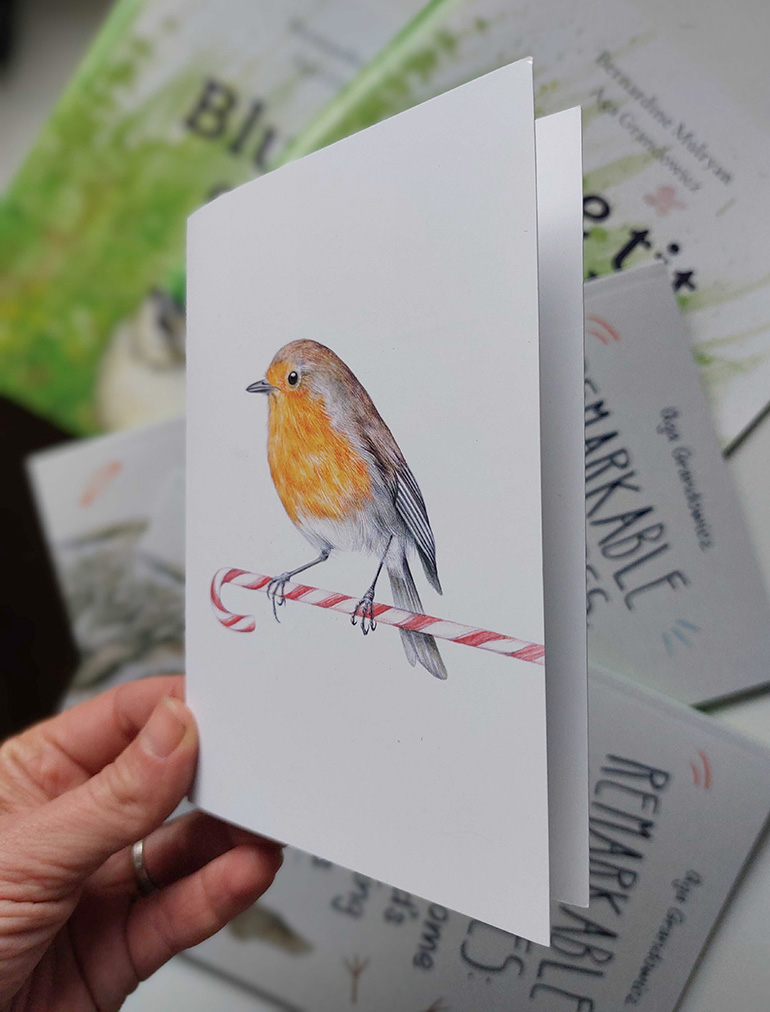
Some birds seem to belong to a particular season. For many people, the European robin (Erithacus rubecula) is the bird of winter: a small splash of warm colour appearing among bare branches, frosted gardens and quiet woodland paths.
Perhaps that is why robins have become so strongly connected with Christmas traditions. Their bright orange-red breast stands out beautifully against winter landscapes, bringing a little warmth to the coldest months of the year.
This illustration started with a slightly unusual idea: a robin perched on a candy cane. A striped stick hanging in the middle of a snowy forest would certainly be an unexpected sight, but the two together perfectly match. The robin's glowing breast echoes the red stripes of the candy cane, creating a little moment where nature and festive imagination meet.
Why Are Robins Associated with Christmas?
The connection between robins and Christmas has a long history, particularly in Britain and Ireland.
During the Victorian era, postmen who delivered Christmas cards wore red uniforms, and they became known as "robins". When illustrated Christmas cards became popular, artists began featuring the actual bird on seasonal designs, and the association grew stronger over time. Today, the robin has become one of the most recognisable symbols of Christmas, appearing on cards, decorations and festive gifts around the world.
But behind the symbolism is a fascinating little bird with a character all of its own.
A Small Bird with a Bold Personality
Despite their delicate appearance, robins are surprisingly confident. They are often curious around humans, especially gardeners, as digging the soil can reveal tasty insects and worms. Many people have experienced the moment when a robin appears nearby while they are working outdoors, quietly waiting for an opportunity to investigate.
Their territorial nature is also impressive. For such a small bird, a robin has a surprisingly strong voice and will defend its patch against rivals. That beautiful song you hear on a winter morning is not just for decoration; it is a way of communicating and protecting its territory.
Robins can also sing throughout much of the year, including winter, when many other birds become quieter.
Bringing a Winter Moment to Life
I created this Christmas robin artwork to capture that feeling of a quiet winter encounter: the stillness of snow, the curiosity of a wild bird and the little moments of unexpected joy that make ordinary days special.
Although the candy cane is a playful addition, the robin itself remains the true focus. Its bright colours, delicate details and confident little pose are what make it such a wonderful subject to draw.
Wildlife illustration is often about observation, but it is also about imagination. Sometimes a real animal can inspire a scene that feels almost magical.
A robin in a snowy woodland may be a familiar sight, but add a tiny festive twist, and suddenly it becomes a story.
Suggested External Links
For readers who want to learn more about robins and Irish birds:
-
BirdWatch Ireland - information about Ireland's native birds and conservation
https://birdwatchireland.ie/ -
National Biodiversity Data Centre Ireland - species records and biodiversity information
https://biodiversityireland.ie/ -
The Cornell Lab of Ornithology - European Robin - detailed bird information
https://www.allaboutbirds.org/