
Some of the most important animals on Earth are the ones we can easily overlook: a bee landing on a flower, a hoverfly resting on a leaf, a moth appearing briefly at dusk. These small creatures support the ecosystems around us, and without them, the natural world would look very different.
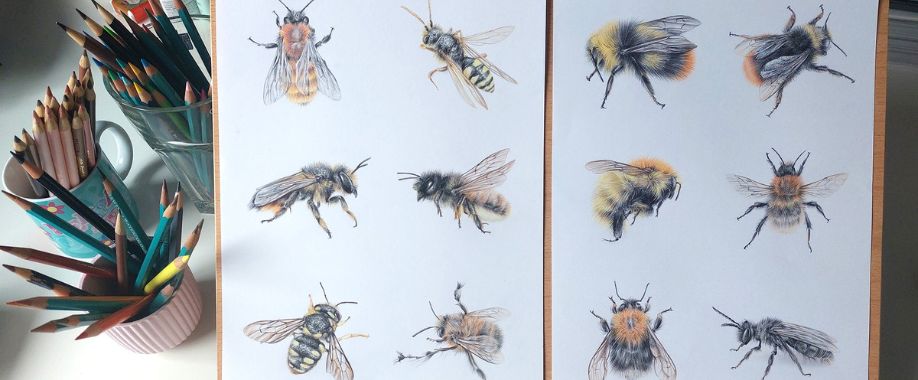
Over the past two weeks, I have been creating a collection of colour pencil drawings of Irish pollinators, focusing on bees, bee flies, hoverflies and one particularly striking moth. This project has been a wonderful opportunity to look more closely at some of the species that share our gardens, meadows and countryside. The closer you look, the more fascinating they become: delicate wings, intricate patterns, tiny hairs designed to collect pollen and colours that are often hidden until you take the time to observe them properly.
The Small Creatures That Keep Nature Moving
Pollinators play a crucial role in maintaining biodiversity. As they move between flowers collecting nectar and pollen, they help plants reproduce and support the wider network of life that depends on them.
Ireland is home to a surprising variety of pollinating insects, from familiar bumblebees to solitary bees that most people rarely notice. Each species has evolved its own unique way of finding food, building nests and surviving in the landscapes around us.
For this collection, I wanted to include not only the bees we commonly recognise, but also some of the less familiar species that deserve more attention.
The drawings include:
-
Tawny Mining Bee (Andrena fulva)
-
Early Bumblebee (Bombus pratorum)
-
Red-tailed Bumblebee (Bombus lapidarius)
-
Common Carder Bumblebee (Bombus pascuorum)
-
Large Carder Bumblebee (Bombus muscorum)
-
Tree Bumblebee (Bombus hypnorum)
-
Ashy Mining Bee (Andrena cineraria)
-
Marsham's Nomad Bee (Nomada marshamella)
-
Brown-footed Leaf-cutter Bee (Megachile versicolor)
-
Red Mason Bee (Osmia bicornis)
-
Wool Carder Bee (Anthidium manicatum)
-
Hairy-footed Flower Bee (Anthophora plumipes)
-
Pied Hoverfly (Scaeva pyrastri)
-
Marmalade Hoverfly (Episyrphus balteatus)
-
White-jawed Yellow-face Bee (Hylaeus confusus)
-
Tiger Moth (Arctia caja)
Discovering the Details
One of the things I love about illustrating insects is discovering how much character they have. A bee is never simply "a bee". Each species has its own combination of colours, textures and adaptations. Some have dense furry coats that help them collect pollen, others have striking markings that make them instantly recognisable, while some have developed fascinating relationships with particular plants.
Colour pencil is an ideal medium for capturing these details. By building up layers gradually, I can recreate the soft textures of a bumblebee's body, the delicate structure of wings and the subtle colour variations that make every species unique.
The process is slow and requires patience, but that is exactly what makes it so rewarding. The more time you spend looking at these tiny creatures, the more there is to discover.
Raising Awareness Through Illustration
These drawings are not only about the visual beauty of pollinators. They are also about encouraging people to notice the wildlife around them.
Many insect species face challenges caused by habitat loss, changes in land management and the decline of wildflower-rich areas. Understanding and appreciating these creatures is an important first step towards protecting them.
In Ireland, initiatives such as the All-Ireland Pollinator Plan are helping to raise awareness of the importance of pollinating insects and the simple actions we can all take to support them. The plan brings together communities, gardeners, farmers, businesses and organisations with the aim of creating a landscape where pollinators can find food, shelter and safe places to thrive. Whether it is planting pollinator-friendly flowers, allowing a patch of grass to grow a little wilder, or simply learning to recognise the species visiting our gardens, everyone can play a part.
Ireland's Hidden Biodiversity
This collection has given me the chance to explore the incredible diversity found in some of Ireland's smallest inhabitants. From the familiar buzz of a bumblebee in a summer garden to the quiet appearance of a moth after sunset, each species has its own story and its own role within the natural world.
I hope these illustrations encourage you to slow down and take a closer look at the creatures around you. They may be tiny, but their impact is enormous.