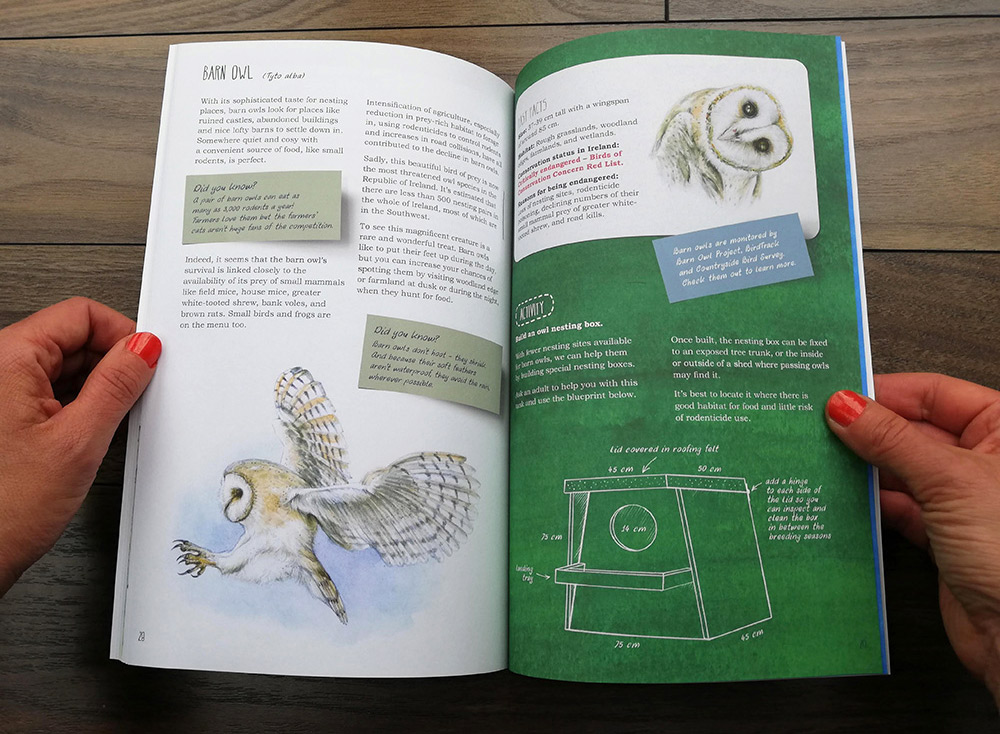
If someone asked you to name Ireland's most successful hunter, your first thought might be the fox, the peregrine falcon or perhaps even the otter. Surprisingly, one of the country's greatest predators spends most of its life hidden from view, gliding silently over fields after sunset. The barn owl is so quiet that many people never realise one has passed overhead. Yet this graceful bird performs one of the most valuable jobs in the Irish countryside. A single breeding pair can consume as many as 3,000 rodents every year, making them one of nature's most effective forms of pest control.
That remarkable fact became one of my favourite discoveries while researching my children's book, 'Remarkable Creatures: A Guide to Some of Ireland's Disappearing Animals'. Like many people, I had admired barn owls for their ghostly beauty, but learning about the sheer number of rodents they remove from farmland completely changed my perspective. Every animal has a role to play within its ecosystem, and the barn owl demonstrates this perfectly. It doesn't simply survive in the landscape; it actively helps to keep nature in balance.
This extraordinary species also inspired one of the illustrations in the book. Rather than simply presenting facts, I wanted children to experience a sense of wonder. Every illustration invites young readers to pause, observe and ask questions. Why do barn owls fly so quietly? How can they hunt in complete darkness? Why are they becoming increasingly rare? Curiosity is often the first step towards conservation, and that is exactly what I hoped the book would encourage.
Although barn owls are widely recognised across Europe, many Irish people have never seen one in the wild. Their secretive lifestyle means they often remain hidden, even in places where they still survive. That makes every sighting feel special, almost magical, and reminds us how fortunate we are whenever nature reveals one of its best-kept secrets.
A Hunter Most People Never See
Barn owls have earned a reputation as silent ghosts of the countryside, and for good reason. Unlike many birds that announce their presence with colourful plumage or cheerful songs, barn owls prefer discretion. They emerge at dusk, hunting over grasslands, farmland and rough meadows while most people are indoors settling down for the evening. Their pale feathers often appear almost white against the fading light, giving them an ethereal appearance that has inspired folklore for centuries.
The true marvel, however, lies in their flight. Barn owls possess specially adapted feathers with soft, comb-like edges that break up the airflow as they fly. Instead of producing the familiar whooshing sound made by most birds, they move through the air in near silence. This extraordinary adaptation allows them to approach prey without warning. A mouse searching for seeds in long grass may never hear the owl until it is too late.
Their hearing is equally astonishing. Barn owls can locate prey using sound alone, even when rodents are completely hidden beneath vegetation or snow. Their facial disc, the heart-shaped arrangement of feathers around their face, acts almost like a satellite dish, directing sound towards their ears. Even more remarkable, their ears are positioned slightly asymmetrically, allowing them to judge the exact location of a tiny rustle with incredible precision.
Watching a barn owl hunt is like observing a perfectly engineered natural machine. Every feature, from the softness of its feathers to the shape of its face, has evolved to make it one of the most efficient nocturnal predators on Earth. Once you understand these adaptations, it becomes impossible not to admire the elegance with which nature solves complex problems.
The Silent Flight That Changed Evolution
Silence is one of the barn owl's greatest superpowers. Most birds rely on speed or strength to catch prey, but the barn owl relies on stealth. Scientists have long studied the structure of owl feathers because they are so remarkably efficient at reducing noise. Engineers have even looked to barn owls for inspiration when designing quieter aircraft, wind turbines and industrial fans. Nature often provides elegant solutions long before humans recognise the problem.
The owl's wings are also exceptionally large compared with its body size. This allows it to fly slowly while remaining airborne, conserving energy during long hunting sessions. Rather than racing across the countryside, it drifts effortlessly over fields, listening intently for movement below. Every glide is deliberate, every turn carefully controlled.
This slow, silent flight also explains why spotting a barn owl is such a memorable experience. Unlike pigeons or crows, which flap noisily overhead, barn owls seem almost unreal. They appear, float across the landscape like a pale spirit, then disappear into darkness just as quickly as they arrived. For many people, that brief encounter becomes a lifelong memory.
It is exactly this sense of wonder that I wanted to capture in the illustration featured in Remarkable Creatures. Wildlife illustration has the unique ability to freeze these fleeting moments, giving children time to appreciate details they might otherwise miss. A single drawing can encourage someone to look differently at the natural world long after they have closed the book.
How One Pair Can Eat Around 3,000 Rodents Every Year
At first glance, the figure almost sounds exaggerated. Three thousand rodents in a single year? Yet when you consider the daily demands of a breeding pair, the maths quickly adds up. Barn owls are active hunters throughout the year, and during the breeding season they face the enormous task of feeding not only themselves but also a brood of rapidly growing chicks. A nest full of hungry youngsters can require dozens of small mammals every night. Every successful hunt contributes to the survival of the next generation, and every vole or mouse caught is one less pest feeding on crops or stored grain.
This remarkable appetite is one reason barn owls have become such valued neighbours in rural communities. Long before pesticides and modern pest-control methods existed, farmers recognised that encouraging owls to nest near their land could dramatically reduce rodent numbers. Unlike chemical solutions, barn owls work continuously, target their natural prey and leave no harmful residues behind. They are a perfect example of an ecosystem functioning as it should, with predators naturally regulating prey populations.
Of course, barn owls are not indiscriminate hunters. They feed mainly on small mammals, particularly field voles, wood mice and shrews. Their diet changes slightly depending on what is available locally, but rodents remain their preferred food. This specialisation means they rarely pose a threat to larger wildlife, livestock or pets, despite occasional misconceptions. In reality, they are among the countryside's most beneficial birds, quietly performing an ecological service that would be difficult and expensive for humans to replicate.
Learning facts like these completely transformed the way I thought about barn owls while researching Remarkable Creatures. It reminded me that every species, no matter how elusive, contributes something valuable to the wider landscape. Children often enjoy impressive statistics, and the idea of an owl eating thousands of rodents each year certainly captures the imagination. Yet behind that surprising number lies an important lesson about biodiversity, balance and the hidden relationships that keep ecosystems healthy.
Nature's Own Pest Control
The phrase "working behind the scenes" could have been invented for barn owls. They rarely receive the attention given to larger or more charismatic animals, yet they make an enormous contribution to the health of farmland. Every mouse caught represents crops protected, grain stores preserved and disease risks reduced. Farmers have understood this for generations, often welcoming barn owls to old barns, churches and outbuildings where they could safely nest.
Today, scientists increasingly recognise the value of these natural predator-prey relationships. Healthy ecosystems are often far more resilient than those that rely heavily on human intervention. When barn owl populations are thriving, they help maintain a natural balance without requiring pesticides or poisons that can unintentionally affect other wildlife. This makes them an important ally in sustainable farming and conservation alike.
There is another benefit that often goes unnoticed. Barn owls serve as indicators of the wider health of the countryside. Because they depend on rough grassland rich in small mammals, their presence suggests that an area still supports a diverse and functioning ecosystem. Where barn owls disappear, it may be a warning that habitats are becoming fragmented or that food sources are declining. Protecting the owl therefore helps protect countless other species that share the same landscape.
This interconnectedness fascinated me while writing the book. It became clear that conservation is rarely about saving a single animal in isolation. Instead, it is about understanding the web of relationships that links plants, insects, mammals and birds together. Barn owls happen to sit near the top of that web, making them both beautiful ambassadors and important guardians of Ireland's countryside.
Why Farmers Appreciate Barn Owls
Ask many farmers what they think of barn owls, and you are likely to hear genuine appreciation. While modern agriculture has changed enormously over the past century, the benefits of having an efficient rodent hunter nearby remain exactly the same. Grain stores attract mice, and where mice gather, predators naturally follow. Barn owls help keep these populations under control in a way that is entirely natural and remarkably efficient.
There is also something reassuring about knowing that wildlife can work alongside farming rather than against it. Too often, conservation and agriculture are presented as opposing interests, when in reality they frequently support one another. Traditional farmyards, hedgerows and species-rich grasslands have long provided ideal habitats for barn owls, while the owls themselves provide an ecological service that benefits the farm. It is a partnership that has developed over centuries.
Sadly, many of the old buildings where barn owls once nested have disappeared or been renovated in ways that exclude wildlife. Old barns have been demolished, roof spaces sealed and mature trees removed. Although these changes are often necessary, they illustrate how easily suitable nesting sites can vanish. Conservation groups now encourage the installation of specially designed nest boxes, giving barn owls safe places to breed where natural cavities no longer exist.
Stories like these are one reason I enjoy writing about wildlife. They reveal that conservation is rarely about dramatic rescues or headline-grabbing events. More often, it is about understanding the small decisions we make every day and recognising how those choices shape the landscapes we all share.
Not Everyone Is Happy About Their Hunting Skills
There is, however, one group that might view barn owls with a touch of suspicion: the farm cats. Both barn owls and cats hunt many of the same small mammals, particularly around farms where food is plentiful. In a sense, they are competitors, although the relationship is rarely dramatic.
The contrast between the two hunters is fascinating. Cats rely heavily on sight and stealth at ground level, creeping slowly towards their prey before launching a sudden pounce. Barn owls, on the other hand, hunt from the air, using extraordinary hearing to detect movement hidden beneath grass. One stalks silently through the farmyard, the other glides silently overhead. Both are superb predators, each perfectly adapted to a different style of hunting.
Humour has always been an important part of how I approach nature writing. Facts are memorable, but stories are unforgettable. A playful observation about farm cats may encourage someone to smile, yet it also opens the door to learning something meaningful about ecology, adaptation and the remarkable diversity of life in Ireland.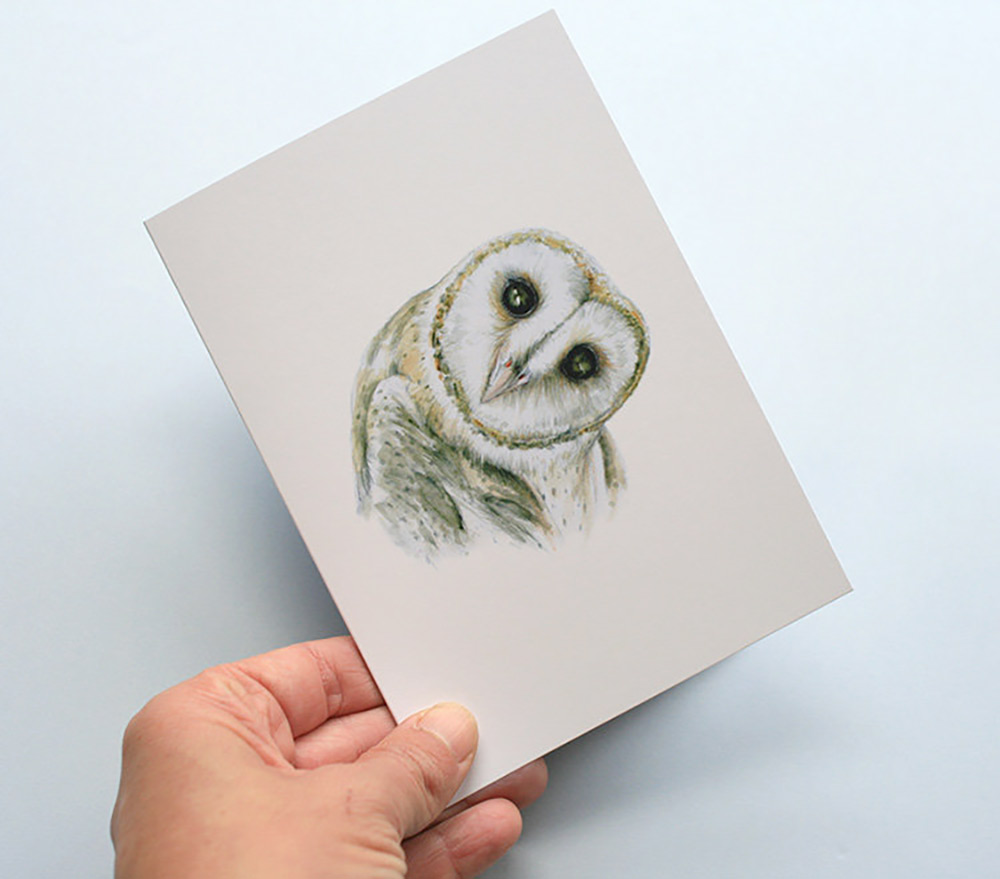

Barn owl – farmers love them, but the farmer’s cats aren’t huge fans of the competition. If you'd like to get this card, you can buy it here.