
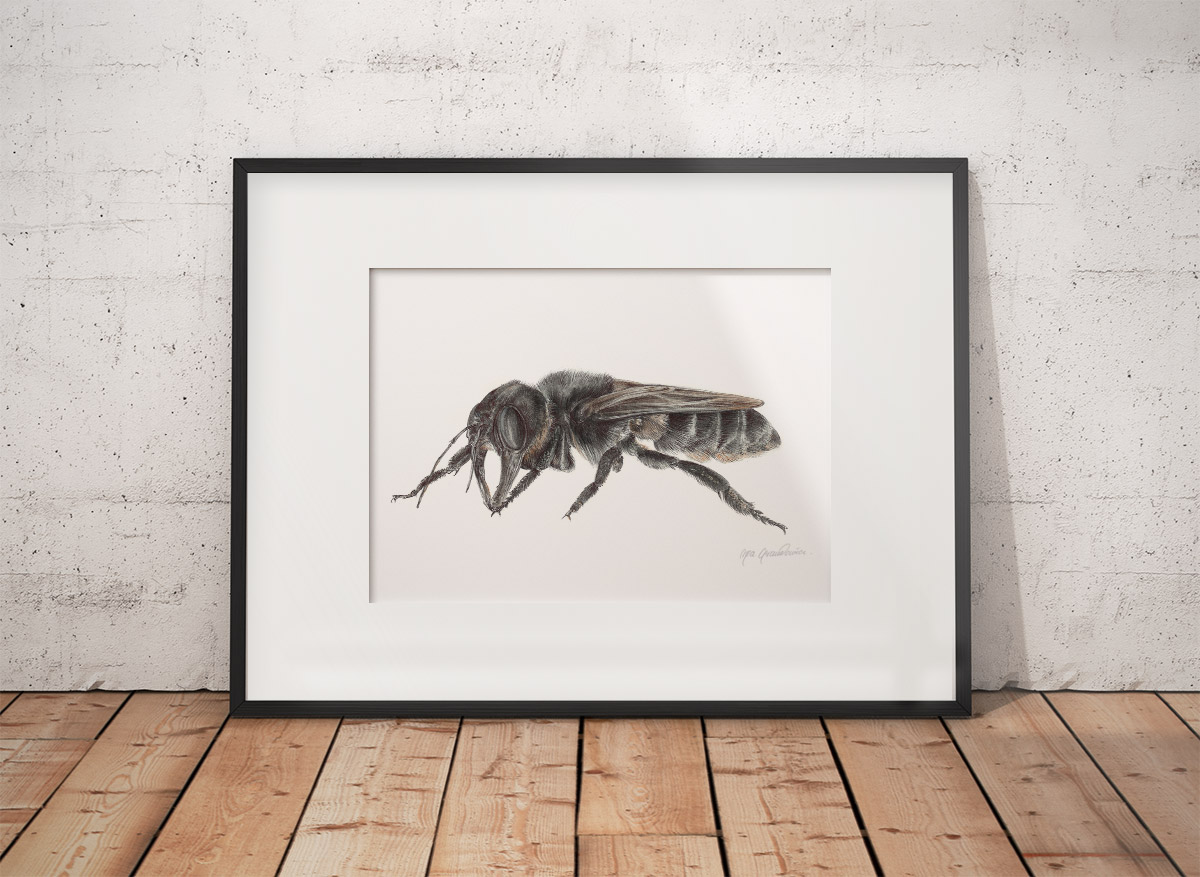
Do you know what the world's largest bee is? The females can grow up to 38mm, about as long as half of my middle finger or about four times the size of a typical honeybee (males are smaller – up to 23mm long – and do not have large jaws). You may call it scary – I call it easier to spot!
Wallace’s giant bee's scientific name is Megachile pluto. It doesn't have anything in common with the well-known Disney's cartoon character, though. Pluto refers to the Roman god of the underworld (known as Hades in Greek mythology). The bee was described by British entomologist Frederick Smith in 1860, but frustratingly (at least for curious people like me), he never explained why he chose that name. Most scientists think it was simply because of its enormous size. Imagine discovering a bee this big for the first time. Giving it the name of a powerful Roman god suddenly doesn't seem so dramatic after all. The first part, Megachile, is easier to decode. It comes from the Greek words mega (large) and cheilos (lip), referring to the large mouthparts typical of leafcutter bees. So, in a way, its name roughly means "Pluto, the giant leafcutter bee".
A Bee Lost... Then Found Again
The story gets even better. Wallace's Giant Bee is found only on a handful of islands in Indonesia's North Maluku archipelago. Unlike the honeybees we commonly see in our gardens, this remarkable insect lives a solitary life. For decades, it became something of a legend. Although Alfred Russel Wallace collected the first specimen in 1858 and Frederick Smith described it two years later, nobody managed to find another one for well over a century. Many people assumed it had disappeared forever. Then, in 1981, American entomologist Adam Messer rediscovered it while studying bees in Indonesia. Imagine finding something the scientific world had almost given up on. And just when you think that's enough excitement, in 2019 another expedition located a living female inside a termite nest and photographed her. It's nice to know nature still has a few surprises left for us.
An Unusual Way of Living
One of the most fascinating things about Wallace's Giant Bee is where it chooses to make its home.
Instead of digging into the ground or nesting in hollow stems like many solitary bees, it depends on active arboreal termite nests. Using sticky tree resin collected with its unusually large jaws, the female builds protected chambers within the termite colony. The resin helps shield her brood from the termites while allowing both species to occupy the same structure. It is a remarkable example of how wildlife can evolve highly specialised relationships with its environment.
A Gentle Giant
Despite its intimidating appearance, Wallace's Giant Bee is not an aggressive insect. Like most solitary bees, females focus on gathering food and raising their young rather than defending a colony. They will sting only if handled or seriously threatened.
Its impressive size has earned it worldwide attention, but its true significance lies in how little we still know about it. Every rediscovery serves as a reminder that some of Earth's most fascinating species remain hidden in the world's forests, waiting to be understood.
Wildlife Art Inspired by Megachile pluto
This drawing is my tribute to one of the most extraordinary bees on Earth. Created from a reference photograph, it celebrates not only the insect's remarkable appearance but also the mystery that has surrounded it for more than 150 years.
Scientific names are often overlooked, yet they can reveal fascinating stories. In the case of Megachile pluto, the name itself reflects the awe this giant bee inspired when it was first encountered. Even today, it still feels like a creature from mythology.
If you enjoy unusual wildlife, rare insects or natural history illustration, I hope this artwork captures a little of that same sense of wonder. And if you'd like it to decorate your home, it's available as the original artwork in my shop here.
