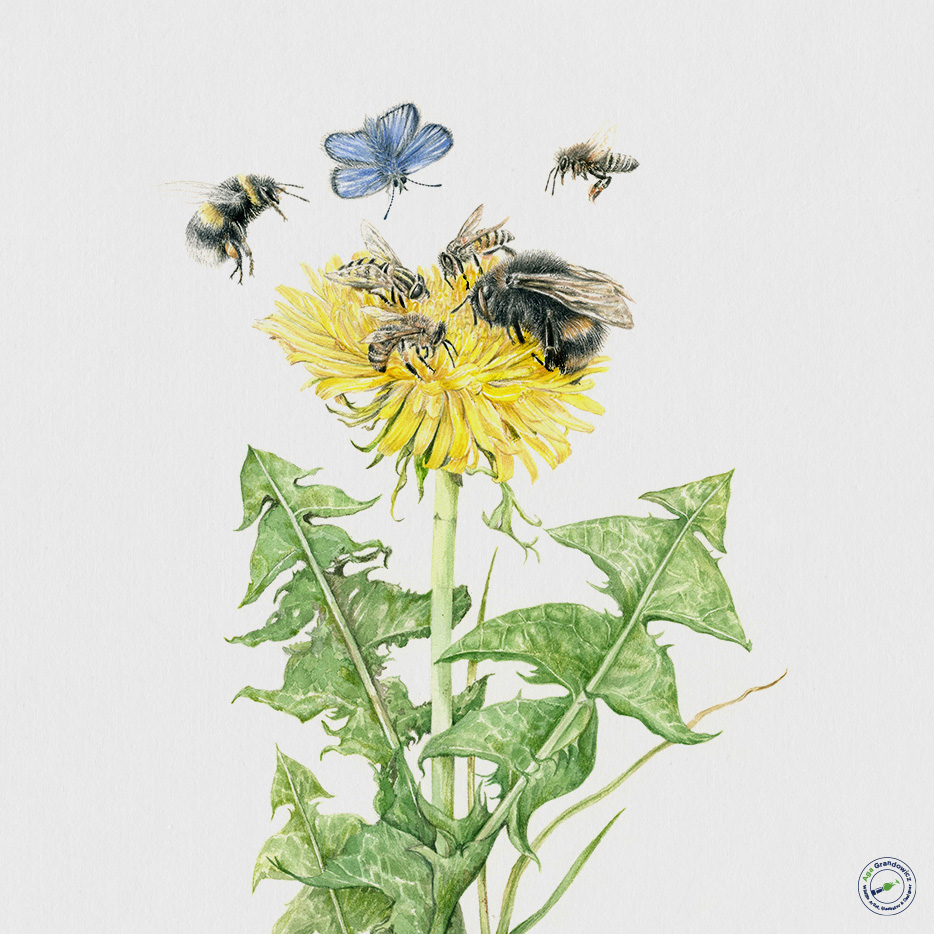
Starving Pollinators is a wildlife illustration exploring one of the less visible consequences of changing landscapes: the difficulty pollinators can face in finding enough food.
Bees, butterflies and other pollinating insects depend on flowering plants for food, but modern landscapes often offer far fewer suitable resources than they once did. Intensively managed gardens, tidied roadsides, loss of wildflower-rich habitats and the decline of diverse plant communities can all reduce the variety of flowers available to insects throughout the year.
At the centre of this illustration is a dandelion, one of the most familiar plants in our everyday surroundings. Often dismissed as a weed and removed from lawns and gardens, dandelions can provide an important source of nectar and pollen, particularly early in the season when relatively few other plants are flowering.
That contrast is what interested me about the subject. A plant that many people regard as untidy or unwanted can be part of a much more important story about biodiversity. Allowing wildflowers to grow, even in small corners of gardens, parks and urban spaces, can create valuable feeding opportunities for insects.
I wanted the illustration to communicate this idea without relying on a large amount of text. The image brings pollinators and their food source together, making their relationship immediately visible. The title, Starving Pollinators, adds another layer to the scene, suggesting what happens when familiar landscapes become increasingly poor in flowers and habitat.
This is an aspect of wildlife illustration that I find particularly rewarding: using a visually engaging image to draw attention to an environmental issue that might otherwise feel abstract. A single illustration can make people pause and reconsider something as ordinary as a dandelion growing in a lawn.
Pollinators are a recurring theme in my work, reflecting my wider interest in Irish biodiversity and the small species that are often overlooked. Bees and butterflies may be tiny, but their relationships with plants are fundamental to functioning ecosystems. Protecting them does not always require dramatic interventions. Sometimes it can begin with allowing a little more space for wildness.
For me, Starving Pollinators is therefore less about depicting a problem and more about encouraging a different way of looking at the landscapes around us. A patch of flowers, an untidy roadside or a dandelion left to grow can all have more ecological value than they first appear to.
The illustration is part of my wider wildlife and natural-history art practice, where I use traditional drawing techniques to explore Irish wildlife, biodiversity and the relationship between species and their habitats.